

For most of us, colon cancer has always belonged to a later chapter of life, something to think about somewhere down the road, well after other health concerns have taken priority. So when a doctor suggests scheduling a colonoscopy at 45, the reaction is often a quiet "already?" Putting it off can feel reasonable. It rarely is. The recommended age to begin screening has moved, and it moved for reasons that have nothing to do with being overly cautious and everything to do with who is actually being diagnosed today.
What Changed, and Why It Happened
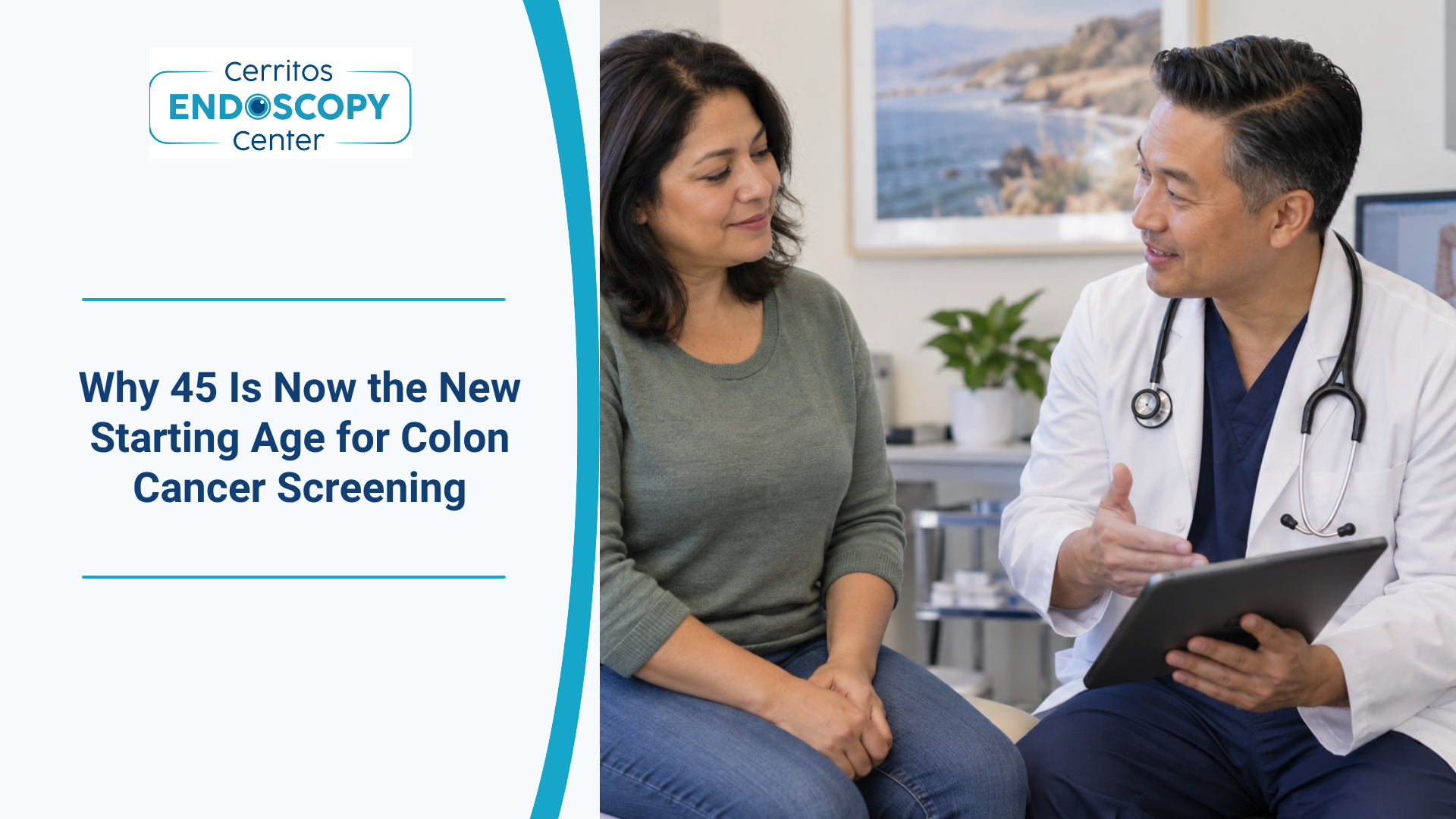
For decades, 50 was the standard age to begin colorectal cancer screening for people at average risk. That benchmark held for a long time, which is part of why the change caught so many people off guard. In 2018, the American Cancer Society lowered its recommended starting age to 45. The U.S. Preventive Services Task Force followed in 2021, updating the official colonoscopy screening age to match.
The reasoning behind the shift is clear, even if the cause of the trend isn't. Colorectal cancer has been rising in adults under 50 since the 1990s, steadily and without an obvious explanation. That trend has grown serious enough that colorectal cancer is now the leading cause of cancer death among men under 50, and the second leading cause among women that age, behind breast cancer. Among adults under 50 as a whole, it has become the single deadliest cancer.
Lowering the age to 45 is meant to catch the disease earlier in a group that, until recently, was not being screened at all.
Who Needs to Start at 45, and Who May Need to Start Earlier
The 45 guideline applies to adults at average risk. In practical terms, that means no current symptoms, no family history of colorectal cancer, and no personal history of polyps or inflammatory bowel disease. If that describes you, 45 is the age to act on, and for most people it settles the question of when to start colon cancer screening.
Not everyone fits that category, though, and for some, waiting until 45 is too long. Earlier screening is often recommended for people with:
- A first-degree relative (parent, sibling, or child) diagnosed with colorectal cancer, in which case screening usually begins at 40, or ten years before the age the relative was diagnosed, whichever comes first
- A personal history of inflammatory bowel disease, such as Crohn's disease or ulcerative colitis
- An inherited condition like Lynch syndrome or familial adenomatous polyposis (FAP)
Risk also isn't spread evenly across the population:
- Black Americans are diagnosed with colorectal cancer more often and face higher mortality from it, and some guidelines have long recommended they begin screening earlier than the general population.
- Hispanic and Latino patients face their own disparities, including notably lower screening rates and, in some studies, disease that appears at younger ages.
For a community as diverse as the one Cerritos Endoscopy Center serves, understanding where you fall on that spectrum is worth a direct conversation with your doctor.
What Screening at 45 Actually Involves
Knowing what screening involves tends to ease the hesitation that comes with scheduling it. For average-risk adults, there are two main paths, and they aren't equally thorough:
- Colonoscopy, once every ten years. This is the gold standard, and for good reason. A colonoscopydoesn't just detect precancerous polyps, it lets the physician remove them in the same visit, before they can ever turn into cancer. Finding and preventing in one procedure is what makes it the benchmark for colorectal cancer prevention.
- Stool-based tests, such as FIT or Cologuard. These can be done at home and appeal to people hoping to skip the preparation a colonoscopy requires. The trade-off is that they screen but don't treat, so a positive result still has to be followed by a colonoscopy to confirm the finding.
Which path makes sense depends on your risk profile and your preferences, and it's exactly the kind of decision a gastroenterologist can help you weigh.
So if you're wondering when should you get your first colonoscopy, the answer for most people is simple: a first colonoscopy at age 45, unless something in your history calls for starting sooner.
Turning 45 Is the Cue to Act
The move to 45 rests on solid ground: colorectal cancer is reaching younger people than it used to, and screening on schedule is one of the most reliable ways to catch it early or prevent it entirely. That makes the age worth acting on, and your individual risk factors worth reviewing right alongside it.
At Cerritos Endoscopy Center, screening is handled start to finish under one roof. The team walks you through which option fits your situation, carries out the colonoscopy itself, and removes any polyps found during the same procedure, so a single visit can move you from question to answer to prevention. If a result needs closer attention, the follow-up care is coordinated right there rather than handed off elsewhere. When you're ready to take that step, you can request an appointment.
FAQs
- Does insurance cover colon cancer screening at 45?
In most cases, yes, as most private plans and Medicare now cover screening at 45 for average-risk adults as preventive care, though it's worth confirming specifics with your plan.
- What if I had a colonoscopy at 50 before the guideline changed; do I need another one sooner?
Generally no, since a normal result still carries the standard ten-year interval, as the lower age affects when to start, not how often.
- Can colon cancer develop with no symptoms at all?
Yes, and that's exactly why screening exists, since polyps and early-stage cancer usually cause no symptoms until the disease is more advanced.
- What is the prep for a colonoscopy actually like?
It's the least pleasant part, but a brief one, clear liquids and a prescribed solution the day before to empty the colon so the exam is accurate.